


Solutions


Device management
Remotely manage, and protect laptops and mobile devices.

Orchestration
Automate tasks across devices, from app installs to scripts.

Software management
Inventory, patch, and manage installed software.

Infrastructure as code
See every change, undo any error, repeat every success.

Extend Fleet
Integrate your favorite tools with Fleet.
Customers
Pricing
More


Device management
Remotely manage, and protect laptops and mobile devices.
Orchestration
Automate tasks across devices, from app installs to scripts.
Software management
Inventory, patch, and manage installed software.
Infrastructure as code
See every change, undo any error, repeat every success.
Extend Fleet
Integrate your favorite tools with Fleet.
Fleet GitOps
The future of device management is declarative
See every change, undo any error, repeat every success. Fleet and GitOps work together to optimize your endpoint management strategy.
Get to know Fleet GitOps
Implement collaboration, version control, and automation workflows built into Fleet that accelerates enforcing controls, OS updates, software deployments, and reduce downtime.
Learn moreBenefits of using infrastructure as code
GUI-based device management practices are difficult to maintain and audit. Undo complex change management and leave manual, repetitive tasks behind. Add real business value in IT and get time back for your team.
Learn moreChallenges
The most common first question about GitOps: “Is it hard?” Acknowledging complexity and meeting resistance with investments in tools and training can help to relieve bottlenecks during adoption.
Learn more
GitOps workshop
Device management is evolving. Master the principles of configuration-as-code for managing devices at scale.
Get to know Fleet GitOps
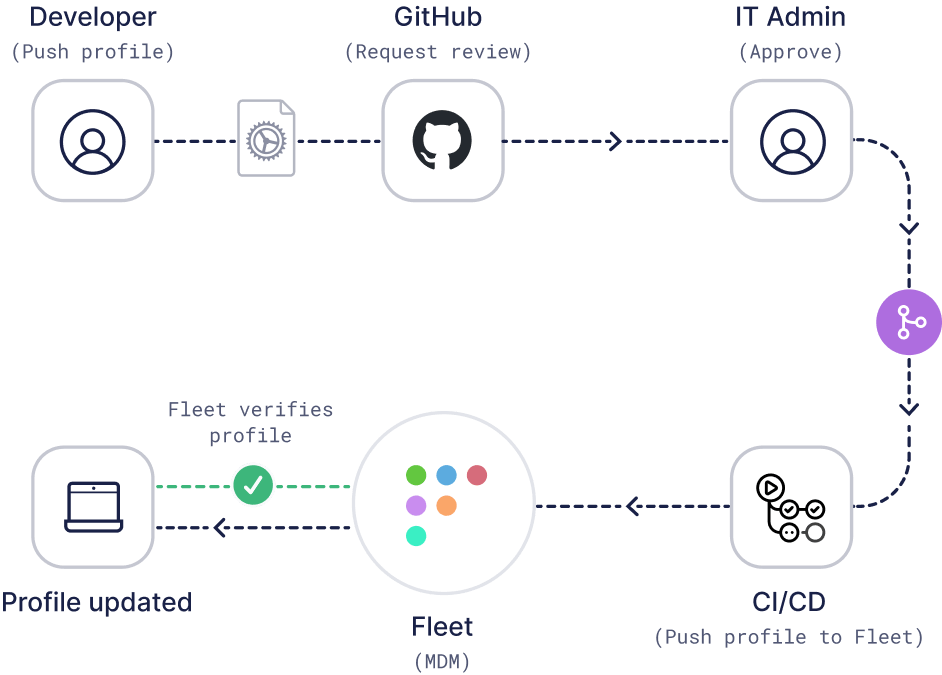
Fleet GitOps commands to modify the Fleet UI are executed by the fleetctl binary (the “engine” under the hood.) The binary lives on a CI / CD “runner” (e.g., GitHub Actions). A git push with updated YAML code kicks off automation that results in real-time changes you can see.
Declarative device management
Most device management solutions have an API, but most do not provide comprehensive control over the admin console with configuration-as-code like Fleet.
Managing the Fleet UI console with GitOps means you have total declarative control over your devices.
Unlock powerful automations that allow you to:
- Ensure every change is peer-reviewed
- Ensure every setting is version-controlled
- Easily roll back to a previous state
- Declare the state of the Fleet UI in code, continuously
Observable, reversible, and repeatable workflows
Nothing builds knowledge, trust, and fosters engineering teamwork like peer-reviewed changes made in the open.
Collaboration on Fleet GitOps workflows helps to prevent problems before they occur. Version control means it is straightforward to fix problems that do make it into production (nobody’s perfect...)
Another powerful technical benefit: less effort on long-term maintenance. Controlling the Fleet UI with code results in a library of stable, known-good configurations that can be copied and modified to easily add new management objects, like device profiles and software. Tame the endless sprawl of manually re-creating automations and scoping.
Benefits of using infrastructure as code
Rethink change managment
Replacing change management forms and risk assessments with asynchronous GitOps workflows and approvals can dramatically increase operational speed.
Stay the course
Changes made in the console or to devices directly can cause device state to “drift” - away from compliance, security posture, and an organization’s intended user experience.
Choose automation over repetition
Applications build muscle memory. But what could you do with the time gained back from manual tasks and visual scans in your current device management solution?
Cancel the CAB
How much does it cost organizations in time and money to get senior engineers and their bosses on an advisory board call to discuss information that could be in a pull request?
Make end users happy
Mired in engineering details, it’s easy to lose sight of an important, oft-stated goal that should be part of any device strategy aimed at operational excellence: enabling work.
“One Fortune 500 company had a 1.5-hour Change Advisory Board (CAB) meeting, 100 attendees, and they reviewed around 50 changes per meeting. This cost them $750k not including opportunity costs.”
Challenges
Your culture matters, and so does ours
For some organizations, GitOps is a natural fit to the engineering culture even if IT teams lack experience or the practice is new.
If DevOps or GitOps is already used by an organization, device management engineers may be aware of the concepts and tooling. Having an internal example to follow can result in an easier path to adoption.
But, GitOps adoption is not always simple. Admins may resist unfamiliar workflows or solutions. They may also have concerns about losing the value of certifications or specialized training.
By meeting potential challenges with phased implementation and thought leadership, any team can successfully adopt Fleet GitOps. We’ve seen it, and we’ve helped our customers do it.
Making GitOps benefits real
At Fleet, we believe that showing organizations how to migrate to GitOps workflows represents an enormous opportunity for them to increase engineering efficiency and operational speed. This ultimately improves both end user experience and enterprise compliance. We design the product around these goals. We want to help you achieve them.
One way we can help is by improving the product itself, which we’re doing every day.
Another way we can help is through training. To learn more about GitOps, you can attend one of our free, hands-on, in-person GitOps workshops, or you can request that one be delivered in your area.
“The shift to GitOps has modernized our operations, giving us the agility and change control we needed, giving leadership real-time confidence in device health and compliance.”

Dan Jackson
Sr Manager Systems Engineering, Fastly
What people are saying
Fleet GitOps
The future of device management is declarative
 SOC2 Type 2


